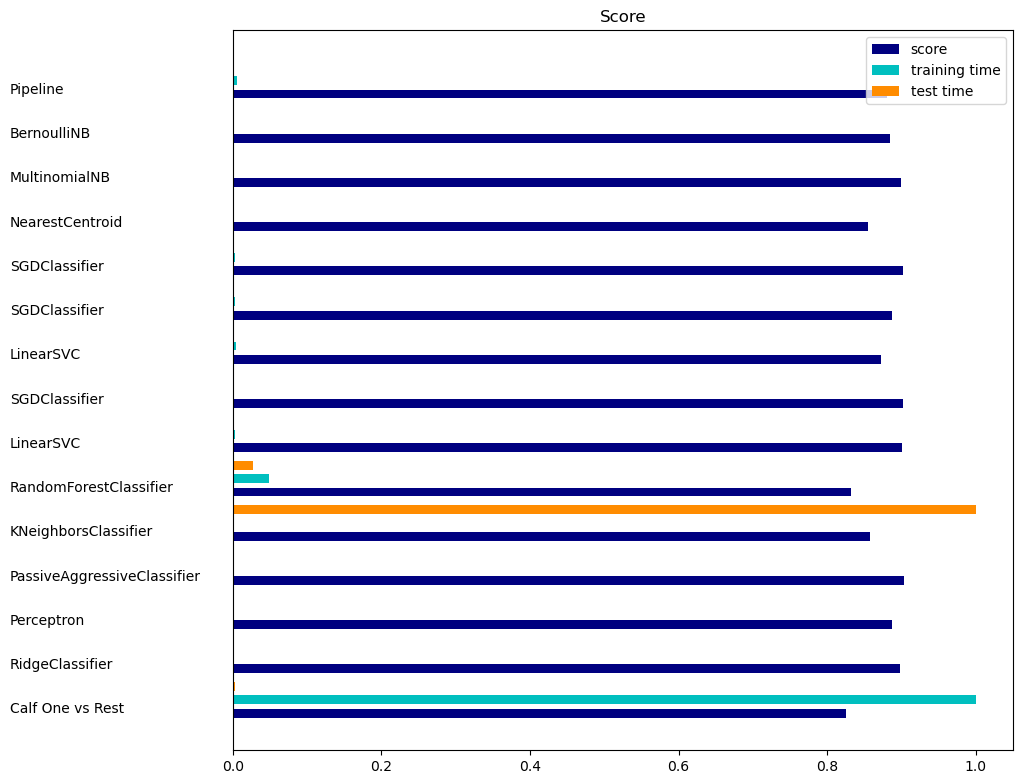
Calf classification performance of multilabel text documents
This is an example showing how Calf can perform multilabel text classification using a one versus the rest strategy. The bar plot shows the performance of each classifier.
[31]:
# Adapted by Rolf Carlson from the Classification of text documents using sparse features
# notebook available at
# https://scikit-learn.org/0.19/_downloads/document_classification_20newsgroups.ipynb

# Here are the authors of the original notebook:
# Author: Peter Prettenhofer <peter.prettenhofer@gmail.com>
#         Olivier Grisel <olivier.grisel@ensta.org>
#         Mathieu Blondel <mathieu@mblondel.org>
#         Lars Buitinck
# License: BSD 3 clause

from __future__ import print_function

import logging
import numpy as np
from optparse import OptionParser
import sys
from time import time
import matplotlib.pyplot as plt

from sklearn.datasets import fetch_20newsgroups
from sklearn.feature_extraction.text import TfidfVectorizer
from sklearn.feature_extraction.text import HashingVectorizer
from sklearn.feature_selection import SelectFromModel
from sklearn.feature_selection import SelectKBest, chi2
from sklearn.linear_model import RidgeClassifier
from sklearn.pipeline import Pipeline
from sklearn.svm import LinearSVC
from sklearn.multiclass import OneVsRestClassifier
from calfcv import Calf, CalfCV
from sklearn.linear_model import SGDClassifier
from sklearn.linear_model import Perceptron
from sklearn.linear_model import PassiveAggressiveClassifier
from sklearn.naive_bayes import BernoulliNB, MultinomialNB
from sklearn.neighbors import KNeighborsClassifier
from sklearn.neighbors import NearestCentroid
from sklearn.ensemble import RandomForestClassifier
from sklearn.utils.extmath import density
from sklearn import metrics


# Display progress logs on stdout
logging.basicConfig(level=logging.INFO,
                    format='%(asctime)s %(levelname)s %(message)s')


# parse commandline arguments
op = OptionParser()
op.add_option("--report",
              action="store_true", dest="print_report",
              help="Print a detailed classification report.")
op.add_option("--chi2_select",
              action="store", type="int", dest="select_chi2",
              help="Select some number of features using a chi-squared test")
op.add_option("--confusion_matrix",
              action="store_true", dest="print_cm",
              help="Print the confusion matrix.")
op.add_option("--top10",
              action="store_true", dest="print_top10",
              help="Print ten most discriminative terms per class"
                   " for every classifier.")
op.add_option("--all_categories",
              action="store_true", dest="all_categories",
              help="Whether to use all categories or not.")
op.add_option("--use_hashing",
              action="store_true",
              help="Use a hashing vectorizer.")
op.add_option("--n_features",
              action="store", type=int, default=2 ** 16,
              help="n_features when using the hashing vectorizer.")
op.add_option("--filtered",
              action="store_true",
              help="Remove newsgroup information that is easily overfit: "
                   "headers, signatures, and quoting.")


def is_interactive():
    return not hasattr(sys.modules['__main__'], '__file__')

# work-around for Jupyter notebook and IPython console
argv = [] if is_interactive() else sys.argv[1:]
(opts, args) = op.parse_args(argv)
if len(args) > 0:
    op.error("this script takes no arguments.")
    sys.exit(1)

print(__doc__)
op.print_help()
print()


# #############################################################################
# Load some categories from the training set
if opts.all_categories:
    categories = None
else:
    categories = [
        'alt.atheism',
        'talk.religion.misc',
        'comp.graphics',
        'sci.space',
    ]

if opts.filtered:
    remove = ('headers', 'footers', 'quotes')
else:
    remove = ()

print("Loading 20 newsgroups dataset for categories:")
print(categories if categories else "all")

data_train = fetch_20newsgroups(subset='train', categories=categories,
                                shuffle=True, random_state=42,
                                remove=remove)

data_test = fetch_20newsgroups(subset='test', categories=categories,
                               shuffle=True, random_state=42,
                               remove=remove)
print('data loaded')

# order of labels in `target_names` can be different from `categories`
target_names = data_train.target_names


def size_mb(docs):
    return sum(len(s.encode('utf-8')) for s in docs) / 1e6

data_train_size_mb = size_mb(data_train.data)
data_test_size_mb = size_mb(data_test.data)

print("%d documents - %0.3fMB (training set)" % (
    len(data_train.data), data_train_size_mb))
print("%d documents - %0.3fMB (test set)" % (
    len(data_test.data), data_test_size_mb))
print("%d categories" % len(categories))
print()

# split a training set and a test set
y_train, y_test = data_train.target, data_test.target

print("Extracting features from the training data using a sparse vectorizer")
t0 = time()
if opts.use_hashing:
    vectorizer = HashingVectorizer(stop_words='english', alternate_sign=False,
                                   n_features=opts.n_features)
    X_train = vectorizer.transform(data_train.data)
else:
    vectorizer = TfidfVectorizer(sublinear_tf=True, max_df=0.5,
                                 stop_words='english')
    X_train = vectorizer.fit_transform(data_train.data)
duration = time() - t0
print("done in %fs at %0.3fMB/s" % (duration, data_train_size_mb / duration))
print("n_samples: %d, n_features: %d" % X_train.shape)
print()

print("Extracting features from the test data using the same vectorizer")
t0 = time()
X_test = vectorizer.transform(data_test.data)
duration = time() - t0
print("done in %fs at %0.3fMB/s" % (duration, data_test_size_mb / duration))
print("n_samples: %d, n_features: %d" % X_test.shape)
print()

# mapping from integer feature name to original token string
if opts.use_hashing:
    feature_names = None
else:
    feature_names = vectorizer.get_feature_names_out()


if opts.select_chi2:
    print("Extracting %d best features by a chi-squared test" %
          opts.select_chi2)
    t0 = time()
    ch2 = SelectKBest(chi2, k=opts.select_chi2)
    X_train = ch2.fit_transform(X_train, y_train)
    X_test = ch2.transform(X_test)
    if len(feature_names) > 0:
        # keep selected feature names
        feature_names = [feature_names[i] for i
                         in ch2.get_support(indices=True)]
    print("done in %fs" % (time() - t0))
    print()

if len(feature_names):
    feature_names = np.asarray(feature_names)


def trim(s):
    """Trim string to fit on terminal (assuming 80-column display)"""
    return s if len(s) <= 80 else s[:77] + "..."


# #############################################################################
# Benchmark classifiers
def benchmark(clf):
    print('_' * 80)
    print("Training: ")
    print(clf)
    t0 = time()
    clf.fit(X_train, y_train)
    train_time = time() - t0
    print("train time: %0.3fs" % train_time)

    t0 = time()
    pred = clf.predict(X_test)
    test_time = time() - t0
    print("test time:  %0.3fs" % test_time)

    score = metrics.accuracy_score(y_test, pred)
    print("accuracy:   %0.3f" % score)

    if hasattr(clf, 'coef_'):
        print("dimensionality: %d" % clf.coef_.shape[1])
        print("density: %f" % density(clf.coef_))

        if opts.print_top10 and feature_names is not None:
            print("top 10 keywords per class:")
            for i, label in enumerate(target_names):
                top10 = np.argsort(clf.coef_[i])[-10:]
                print(trim("%s: %s" % (label, " ".join(feature_names[top10]))))
        print()

    if opts.print_report:
        print("classification report:")
        print(metrics.classification_report(y_test, pred,
                                            target_names=target_names))

    if opts.print_cm:
        print("confusion matrix:")
        print(metrics.confusion_matrix(y_test, pred))

    print()
    clf_descr = str(clf).split('(')[0]
    if clf_descr == 'OneVsRestClassifier':
        clf_descr = 'Calf One vs Rest'
    return clf_descr, score, train_time, test_time


results = []
for clf, name in (
        (OneVsRestClassifier(Calf(order_col=True)), "Calf OVR"),
        (RidgeClassifier(tol=1e-2, solver="lsqr"), "Ridge Classifier"),
        (Perceptron(), "Perceptron"),
        (PassiveAggressiveClassifier(), "Passive-Aggressive"),
        (KNeighborsClassifier(n_neighbors=10), "kNN"),
        (RandomForestClassifier(n_estimators=100), "Random forest")):
    print('=' * 80)
    print(name)
    results.append(benchmark(clf))

for penalty in ["l2", "l1"]:
    print('=' * 80)
    print("%s penalty" % penalty.upper())
    # Train Liblinear model
    results.append(benchmark(LinearSVC(penalty=penalty, dual=False,
                                       tol=1e-3)))

    # Train SGD model
    results.append(benchmark(SGDClassifier(alpha=.0001,
                                           penalty=penalty)))

# Train SGD with Elastic Net penalty
print('=' * 80)
print("Elastic-Net penalty")
results.append(benchmark(SGDClassifier(alpha=.0001,
                                       penalty="elasticnet")))

# Train NearestCentroid without threshold
print('=' * 80)
print("NearestCentroid (aka Rocchio classifier)")
results.append(benchmark(NearestCentroid()))

# Train sparse Naive Bayes classifiers
print('=' * 80)
print("Naive Bayes")
results.append(benchmark(MultinomialNB(alpha=.01)))
results.append(benchmark(BernoulliNB(alpha=.01)))

print('=' * 80)
print("LinearSVC with L1-based feature selection")
# The smaller C, the stronger the regularization.
# The more regularization, the more sparsity.
results.append(benchmark(Pipeline([
  ('feature_selection', SelectFromModel(LinearSVC(penalty="l1", dual=False,
                                                  tol=1e-3))),
  ('classification', LinearSVC(penalty="l2", dual='auto'))])))

# make some plots

indices = np.arange(len(results))

results = [[x[i] for x in results] for i in range(4)]

clf_names, score, training_time, test_time = results
training_time = np.array(training_time) / np.max(training_time)
test_time = np.array(test_time) / np.max(test_time)

plt.figure(figsize=(12, 8))
plt.title("Score")
plt.barh(indices, score, .2, label="score", color='navy')
plt.barh(indices + .3, training_time, .2, label="training time",
         color='c')
plt.barh(indices + .6, test_time, .2, label="test time", color='darkorange')
plt.yticks(())
plt.legend(loc='best')
plt.subplots_adjust(left=.25)
plt.subplots_adjust(top=.95)
plt.subplots_adjust(bottom=.05)

for i, c in zip(indices, clf_names):
    plt.text(-.3, i, c)

plt.show()
Automatically created module for IPython interactive environment
Usage: ipykernel_launcher.py [options]

Options:
  -h, --help            show this help message and exit
  --report              Print a detailed classification report.
  --chi2_select=SELECT_CHI2
                        Select some number of features using a chi-squared
                        test
  --confusion_matrix    Print the confusion matrix.
  --top10               Print ten most discriminative terms per class for
                        every classifier.
  --all_categories      Whether to use all categories or not.
  --use_hashing         Use a hashing vectorizer.
  --n_features=N_FEATURES
                        n_features when using the hashing vectorizer.
  --filtered            Remove newsgroup information that is easily overfit:
                        headers, signatures, and quoting.

Loading 20 newsgroups dataset for categories:
['alt.atheism', 'talk.religion.misc', 'comp.graphics', 'sci.space']
data loaded
2034 documents - 3.980MB (training set)
1353 documents - 2.867MB (test set)
4 categories

Extracting features from the training data using a sparse vectorizer
done in 0.444263s at 8.958MB/s
n_samples: 2034, n_features: 33809

Extracting features from the test data using the same vectorizer
done in 0.279947s at 10.243MB/s
n_samples: 1353, n_features: 33809

================================================================================
Calf OVR
________________________________________________________________________________
Training:
OneVsRestClassifier(estimator=Calf(order_col=True))
train time: 47.600s
test time:  0.013s
accuracy:   0.825

================================================================================
Ridge Classifier
________________________________________________________________________________
Training:
RidgeClassifier(solver='lsqr', tol=0.01)
train time: 0.071s
test time:  0.003s
accuracy:   0.899
dimensionality: 33809
density: 1.000000


================================================================================
Perceptron
________________________________________________________________________________
Training:
Perceptron()
train time: 0.033s
test time:  0.003s
accuracy:   0.888
dimensionality: 33809
density: 0.255302


================================================================================
Passive-Aggressive
________________________________________________________________________________
Training:
PassiveAggressiveClassifier()
train time: 0.052s
test time:  0.003s
accuracy:   0.904
dimensionality: 33809
density: 0.692057


================================================================================
kNN
________________________________________________________________________________
Training:
KNeighborsClassifier(n_neighbors=10)
train time: 0.001s
test time:  4.387s
accuracy:   0.858

================================================================================
Random forest
________________________________________________________________________________
Training:
RandomForestClassifier()
train time: 2.286s
test time:  0.121s
accuracy:   0.832

================================================================================
L2 penalty
________________________________________________________________________________
Training:
LinearSVC(dual=False, tol=0.001)
train time: 0.122s
test time:  0.002s
accuracy:   0.900
dimensionality: 33809
density: 1.000000


________________________________________________________________________________
Training:
SGDClassifier()
train time: 0.034s
test time:  0.002s
accuracy:   0.902
dimensionality: 33809
density: 0.574751


================================================================================
L1 penalty
________________________________________________________________________________
Training:
LinearSVC(dual=False, penalty='l1', tol=0.001)
train time: 0.223s
test time:  0.002s
accuracy:   0.873
dimensionality: 33809
density: 0.005553


________________________________________________________________________________
Training:
SGDClassifier(penalty='l1')
train time: 0.134s
test time:  0.002s
accuracy:   0.888
dimensionality: 33809
density: 0.022346


================================================================================
Elastic-Net penalty
________________________________________________________________________________
Training:
SGDClassifier(penalty='elasticnet')
train time: 0.142s
test time:  0.002s
accuracy:   0.902
dimensionality: 33809
density: 0.188848


================================================================================
NearestCentroid (aka Rocchio classifier)
________________________________________________________________________________
Training:
NearestCentroid()
train time: 0.004s
test time:  0.002s
accuracy:   0.855

================================================================================
Naive Bayes
________________________________________________________________________________
Training:
MultinomialNB(alpha=0.01)
train time: 0.005s
test time:  0.002s
accuracy:   0.899

________________________________________________________________________________
Training:
BernoulliNB(alpha=0.01)
train time: 0.007s
test time:  0.005s
accuracy:   0.884

================================================================================
LinearSVC with L1-based feature selection
________________________________________________________________________________
Training:
Pipeline(steps=[('feature_selection',
                 SelectFromModel(estimator=LinearSVC(dual=False, penalty='l1',
                                                     tol=0.001))),
                ('classification', LinearSVC(dual='auto'))])
train time: 0.240s
test time:  0.002s
accuracy:   0.880