The N2 dataset
The N2 dataset provides features that are hypothesized to be informative for a progression to psychosis. This notebook provides an overview of N2.
[68]:
# Author: Rolf Carlson, Carlson Research LLC, <hrolfrc@gmail.com>
# License: 3-clause BSD
[69]:
import pandas
from sklearn.linear_model import LogisticRegression
from sklearn.metrics import RocCurveDisplay
from sklearn.metrics import roc_auc_score
import matplotlib.pyplot as plt
import math
from sklearn.model_selection import train_test_split
Get the input file path from the calf project
[70]:
input_file_path = "../../../data/n2.csv"
Read the input file into a DataFrame
[71]:
df = pandas.read_csv(input_file_path, header=0, sep=",")
df.head()
[71]:
| ctrl/case | ADIPOQ | SERPINA3 | AMBP | A2M | ACE | AGT | APOA1 | APOA2 | APOA4 | ... | CALCA | IL6 | LTA | CSF3 | PGF | GCG_0001 | IL1B | TGFB3 | FGF2 | MDA-LDL | |
|---|---|---|---|---|---|---|---|---|---|---|---|---|---|---|---|---|---|---|---|---|---|
| 0 | 0 | 1.1538 | -1.008 | 0.4650 | -0.6181 | -0.9350 | 1.7169 | 0.974 | 1.7821 | -0.2580 | ... | -0.3688 | 0.8739 | -0.2390 | 2.8335 | 0.4469 | 0.101 | 0.1688 | -0.1861 | 1.9591 | -0.0720 |
| 1 | 0 | -0.7661 | -1.039 | 1.2479 | 0.2220 | -0.7140 | 2.6709 | -0.275 | 0.1680 | 0.9759 | ... | -0.3688 | 1.5408 | 3.5482 | -0.6669 | -0.7770 | 1.015 | 0.1688 | 0.2689 | -0.3498 | -0.5491 |
| 2 | 0 | -0.2721 | -0.766 | -0.7480 | -1.0371 | 0.0459 | -0.2940 | 0.046 | 0.9320 | -0.5050 | ... | 0.2562 | 0.2060 | -0.8099 | -0.6669 | -0.7770 | 0.372 | -0.5152 | -0.1861 | -0.3498 | -0.5491 |
| 3 | 0 | -0.8201 | -1.281 | 0.4650 | -0.1980 | 0.8059 | 0.8980 | -0.954 | -0.4270 | -0.5050 | ... | -0.3688 | -0.5718 | -0.8099 | -0.6669 | -0.5050 | -0.543 | 0.1688 | 0.2689 | -0.5978 | -0.5491 |
| 4 | 0 | 0.0019 | -1.188 | -0.7090 | 0.6421 | 0.2039 | -0.3500 | -0.275 | 0.5070 | 0.2349 | ... | 0.0612 | 1.8737 | 1.0388 | -0.6669 | 0.4469 | 0.575 | -0.2332 | -0.4131 | 0.4472 | -0.5491 |
5 rows × 136 columns
Remove the outcome column to get the independent variables
[72]:
X = df.loc[:, df.columns != 'ctrl/case']
X.head()
[72]:
| ADIPOQ | SERPINA3 | AMBP | A2M | ACE | AGT | APOA1 | APOA2 | APOA4 | APOH | ... | CALCA | IL6 | LTA | CSF3 | PGF | GCG_0001 | IL1B | TGFB3 | FGF2 | MDA-LDL | |
|---|---|---|---|---|---|---|---|---|---|---|---|---|---|---|---|---|---|---|---|---|---|
| 0 | 1.1538 | -1.008 | 0.4650 | -0.6181 | -0.9350 | 1.7169 | 0.974 | 1.7821 | -0.2580 | 2.6529 | ... | -0.3688 | 0.8739 | -0.2390 | 2.8335 | 0.4469 | 0.101 | 0.1688 | -0.1861 | 1.9591 | -0.0720 |
| 1 | -0.7661 | -1.039 | 1.2479 | 0.2220 | -0.7140 | 2.6709 | -0.275 | 0.1680 | 0.9759 | 0.4610 | ... | -0.3688 | 1.5408 | 3.5482 | -0.6669 | -0.7770 | 1.015 | 0.1688 | 0.2689 | -0.3498 | -0.5491 |
| 2 | -0.2721 | -0.766 | -0.7480 | -1.0371 | 0.0459 | -0.2940 | 0.046 | 0.9320 | -0.5050 | -0.0990 | ... | 0.2562 | 0.2060 | -0.8099 | -0.6669 | -0.7770 | 0.372 | -0.5152 | -0.1861 | -0.3498 | -0.5491 |
| 3 | -0.8201 | -1.281 | 0.4650 | -0.1980 | 0.8059 | 0.8980 | -0.954 | -0.4270 | -0.5050 | 1.3320 | ... | -0.3688 | -0.5718 | -0.8099 | -0.6669 | -0.5050 | -0.543 | 0.1688 | 0.2689 | -0.5978 | -0.5491 |
| 4 | 0.0019 | -1.188 | -0.7090 | 0.6421 | 0.2039 | -0.3500 | -0.275 | 0.5070 | 0.2349 | -0.6120 | ... | 0.0612 | 1.8737 | 1.0388 | -0.6669 | 0.4469 | 0.575 | -0.2332 | -0.4131 | 0.4472 | -0.5491 |
5 rows × 135 columns
[73]:
# computing number of rows
rows = len(X.axes[0])

# computing number of columns
cols = len(X.axes[1])

print("Number of Rows (data points): ", rows)
print("Number of Columns (features or variables): ", cols)
Number of Rows (data points):  72
Number of Columns (features or variables):  135
[74]:
Y = df['ctrl/case']
Y represents whether the individuals became psychotic (1) or not (0). Y is a Pandas series.
[75]:
Y.head()
[75]:
0    0
1    0
2    0
3    0
4    0
Name: ctrl/case, dtype: int64
[76]:
Y.describe()
[76]:
count    72.000000
mean      0.444444
std       0.500391
min       0.000000
25%       0.000000
50%       0.000000
75%       1.000000
max       1.000000
Name: ctrl/case, dtype: float64
The individuals who did not progress to psychosis are labeled non_psychotic.
[77]:
non_psychotic = Y[Y == 0]
non_psychotic.head()
[77]:
0    0
1    0
2    0
3    0
4    0
Name: ctrl/case, dtype: int64
The individuals who progressed to psychosis are labeled pre_psychotic.
[78]:
pre_psychotic = Y[Y == 1]
[79]:
pre_psychotic.head()
[79]:
40    1
41    1
42    1
43    1
44    1
Name: ctrl/case, dtype: int64
[80]:
Y_names = Y.replace({0: 'non_psychotic', 1: 'pre_psychotic'})
Y_names
[80]:
0     non_psychotic
1     non_psychotic
2     non_psychotic
3     non_psychotic
4     non_psychotic
          ...
67    pre_psychotic
68    pre_psychotic
69    pre_psychotic
70    pre_psychotic
71    pre_psychotic
Name: ctrl/case, Length: 72, dtype: object
Fit N2
[81]:
lr = LogisticRegression().fit(X, Y)
[82]:
importance = lr.coef_.tolist()[0]
# Find the 5 most important coefficients and features
# Operate on the coefficients and features as tuples
# maintain the association as they are sorted and selected.
tup = list(zip(importance, X.columns))
tup = sorted(tup,  key=lambda c: abs(c[0]), reverse=True)[0:10]
tup = [c for c in tup if not math.isclose(c[0], 0)]

s, f = list(zip(*tup))

fig, ax = plt.subplots()
ax.bar(height=s, x=f)

plt.xticks(rotation=50)
plt.title("Feature importances via coefficients")
plt.show()
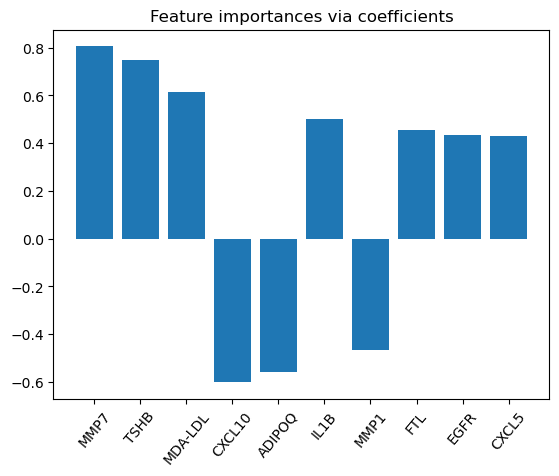
Most important coefficients and features written as a sum
[83]:
i, j = tup[0]
s = str(round(i, 3)) + " " +str(j)
for i, j in tup[1:]:
    if i < 0:
        sgn = ' '
    else:
        sgn = ' + '
    s = s + sgn + str(round(i, 3)) + " " +str(j)
print(s)
0.805 MMP7 + 0.75 TSHB + 0.614 MDA-LDL -0.602 CXCL10 -0.558 ADIPOQ + 0.502 IL1B -0.469 MMP1 + 0.456 FTL + 0.434 EGFR + 0.431 CXCL5
The ROC AUC score
[84]:
y_score = lr.predict(X)
# Using all the data should result in an AUC near 1
roc_auc_score(Y, y_score)
[84]:
1.0
ROC curve with an AUC = 1
[85]:
RocCurveDisplay.from_predictions(
    Y,
    y_score,
    name="Conversion to Psychosis",
    color="darkorange",
)
plt.plot([0, 1], [0, 1], "k--", label="chance level (AUC = 0.5)")
plt.axis("square")
plt.xlabel("False Positive Rate")
plt.ylabel("True Positive Rate")
plt.title("ROC curves")
plt.legend()
plt.show()
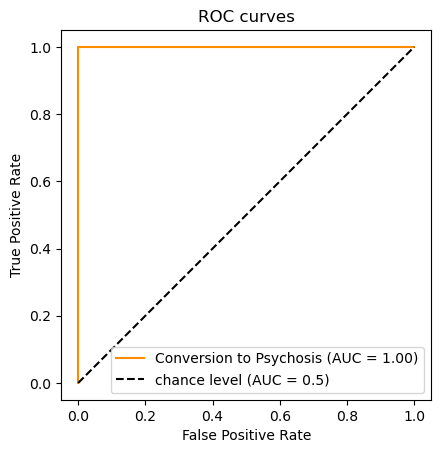
The classifier does not learn from the training data.
[86]:
X_train, X_test, y_train, y_test = train_test_split(
    X.copy(), Y.copy(),
    random_state=42
)
[87]:
y_score =  LogisticRegression().fit(X_train, y_train).predict(X_test)
# Using all the data should result in an AUC near 1
roc_auc_score(y_test, y_score)
[87]:
0.48701298701298695